

Suspended Timber Floor Insulation - Your How To Guide
Before you start
Check for damp / damage / rot
It’s important to check for, and remedy any moisture, rot or damage to the floor timbers before installing insulation.
Lag pipes below ground level
Once the floor has been insulated the space below will no longer be warmed by the heat in the room above. Any pipes that sit within this space should be lagged to protect against freezing.
Check the underfloor ventilation
Lack of ventilation below the floor will encourage damp and rot. Ensure that space is well ventilated. Existing vents may need to be repaired or unblocked. Any low intermediate, supporting walls below floor level should have air gaps in them to allow air movement across the entire floor area.
Recommended insulation types:
Flexible insulation allows a tight fit and Natural Fibre provides improved moisture handling, due to it’s hygroscopic nature. We recommend, sheepswool, hemp or flexible woodfibre.
Membranes and tapes. The benefit of an airtight system.
Using membranes and tapes to create a sealed envelope for the insulation improves the thermal efficiency by reducing the movement of warm air through the insulation. Membranes installed on the cold side of the insulation help to control condensation. They will also stop wind-wash, a phenomenon that occurs when cold air moves across the insulation surface. The cold air pulls away the warm air stored in the insulation, reducing it’s thermal efficiency.
Method 1 - Insulating a suspended timber floor from above
To Insulate a suspended floor from above, you will need to remove the floorboards to access the joists.
We also recommend removing the skirting boards to allow the membranes to be taped to the walls. When replaced, the skirtings will hide the tape. Carefully Inspect the joists for any old nails or damaged timber that may pierce the membrane.
Step 1. Fitting the coldside breather membrane
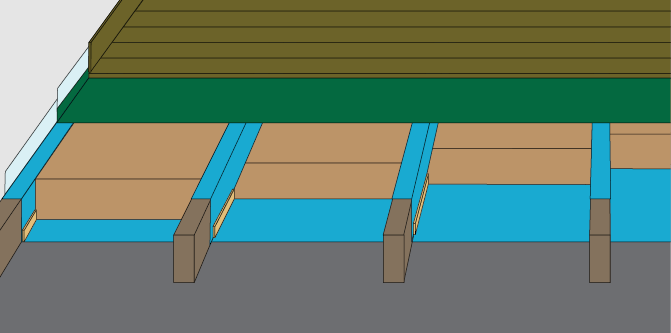
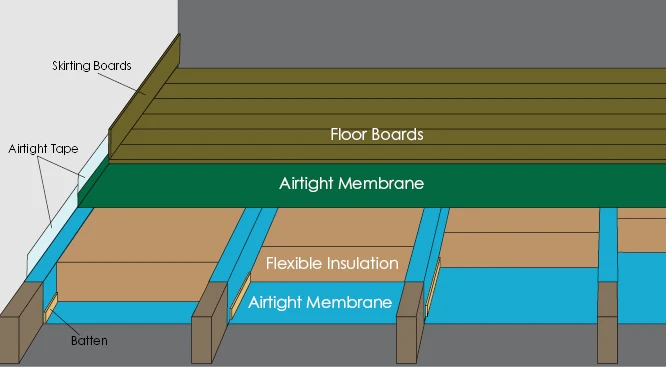
Using a cold-side breather membrane (e.g. Proclima Solitex Plus), run lengths across the top of the joists, pushing it down between the timbers to create troughs for the insulation. Hold the insulation in place using staples, ensuring the membrane is tight to the sides of the joists. Fix thin battens along the bottom edge of the joists to hold the corners of the troughs square. (see diagram 1.1 below)
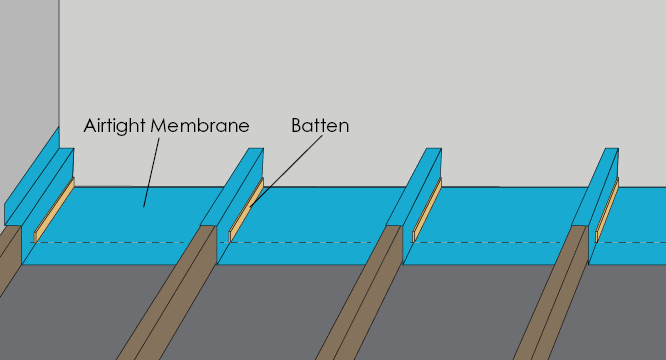
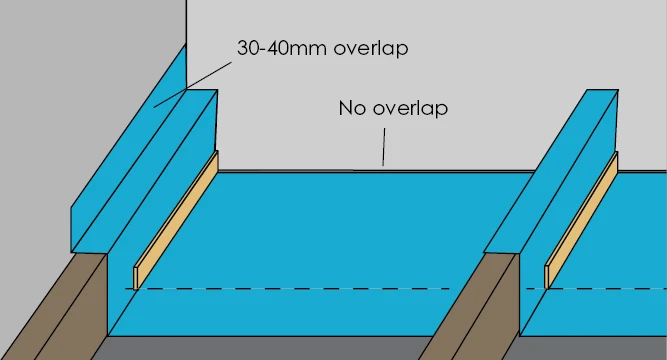
Run the first strip of membrane with the long edge tight against the wall, ensuring there is little to no gap. At either end of the length, allow 30-40mm of membrane to run up the wall. (see diagram 1.2 below)
Note. If the floor joists and wall are out of square, install the first strip of membrane parallel and tight to the wall. Subsequent lengths can then be run perpendicular to the joists, ensuring there is enough overlap to meet the minimum requirement of 100mm (see diagram 1.3 below).
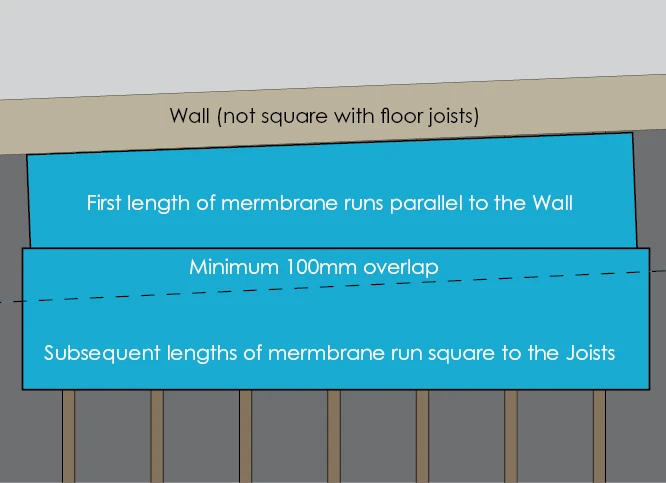
Continue to run lengths of membrane taking care to retain the 100mm overlap.
Once the area floor is covered, seal the overlaps with an airtight tape (e.g. Proclima Tescon Vana).
Any pipes or cables that pass through the membrane should also be sealed with the Proclima Tescon Vana airtight tape or with an airtight grommet (e.g. Pro Clima Kaflex / Roflex Grommets).
Taping the membranes to the walls
Seal the edges of the membrane to the Walls using Pro Clima Contega Solido SL Tape.
To ensure a good bond to the walls, make sure the surfaces are clean and free of dust. If necessary, prime the area with the Tescon Sprimer which will create a strong bond with the air tight tape.
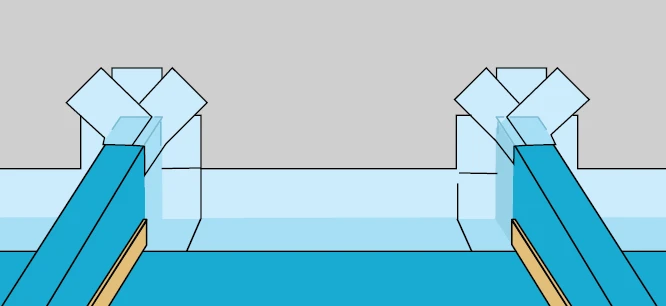
For the walls that are at the ends of the joists, cut pieces of tape long enough to seal the membrane around the joist ends and across the bottom of the trough. Fix in place, overlapping the tape pieces to ensure there are no air gaps. (see diagram 1.4 below).
For the walls that run parallel to the joists, turn the end of the membrane up the wall (30-40mm), cut if necessary with a sharp knife and tape in place. (see diagram 1.5 below)
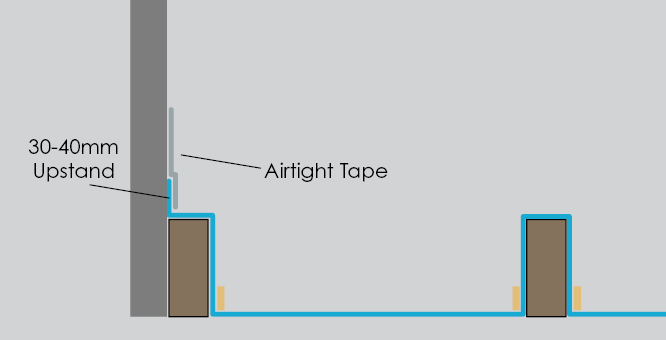
Make sure there are no gaps where the membrane joins the walls.
Finally, check the membrane for any damage and if necessary, repair with the airtight tape.
Step 2. Fitting the insulation
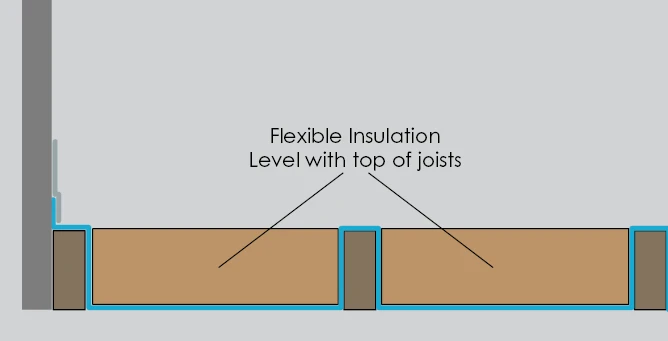
Place your choice of Flexible insulation between the joists, ensuring a tight fit. The dimensions of the insulation should be equal in depth to the joists and slightly wider than the space between the joists. No air gaps are required (see diagram 1.6 below).
Step 3. Fitting the vapour control layer
Once the space between the joists has been filled with insulation, you can install the vapour control layer over the insulation. Staple the Pro Clima DA membrane, across the tops of the joists in the same direction as the airtight membrane, overlapping each length as previously. Treat the connections to the walls in the same way as the airtight membrane, cleaning priming and taping the membrane to the walls to a height that will be covered by the skirting boards. (see diagram 1.7).
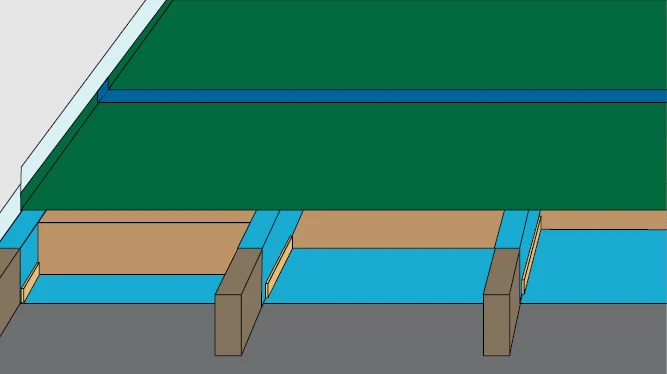
For any difficult areas where the tape does not create a seal, use the Orcon F Sealant. Check the membrane for any damage and if necessary, repair with the airtight tape.
The floor is now ready for the floorboards and skirting to be fitted. Diagram 1.8 below, shows a cross section of the finished installation.
Method 2 - Insulating a suspended timber floor from below
If you are unable to lift the floorboards, it is possible to fit the insulation from below, provided there is a sufficient crawl space. This method can be a bit trickier than fixing from above; however, with patience, it is possible.
Refer to the checklist in the ‘Before You Start’ Section.
Health and safety considerations
Because you will be working below floor level and possibly in a confined space, we recommend carrying out a risk assessment. We also advise the wearing of suitable strong work clothing and a dust mask/respirator. Be aware of any exposed nails or damaged timber which may cause injury.
Step 1. Fitting the vapour control layer below the floorboards
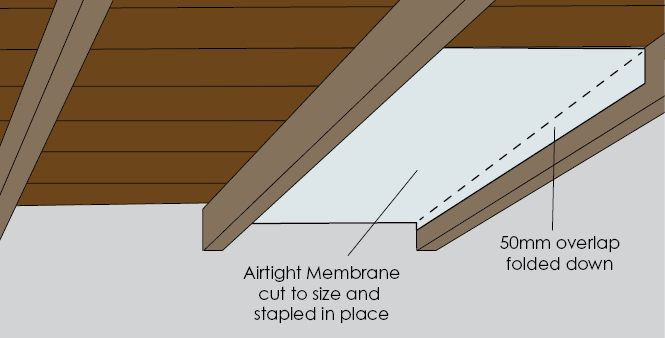
Measure the distance between the joists and then add an extra 100mm (50mm overlap either side). Use the measurement to cut strips of membrane. For this method of installation we recommend the Pro Clima Intello Plus smart membrane. Run the strips of membrane between the joists with the 50mm overlap running down the sides of the joists. Hold the membrane in place by stapling it to the underside of the floor boards or to the top part of the joists. (see diagram 2.0 below).
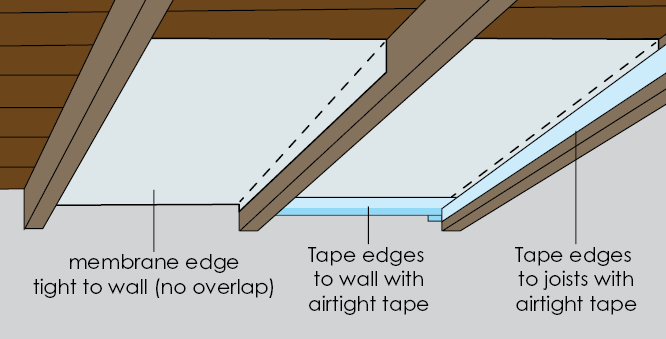
Where the membrane touches the walls, position the edge as close as possible, making sure not to fold any membrane down the wall. Seal the joins and overlaps with the Contega Solido Airtight tape. (see diagram 2.1 below).
Step 2. Fitting the insulation
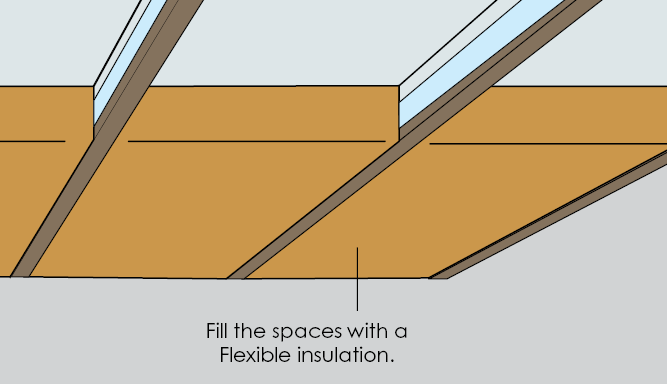
Place your choice of Flexible insulation between the joists ensuring a tight fit. The dimensions of the insulation should be equal in depth to the joists and slightly wider than the space between the joists. No air gaps are required (see diagram 2.2 below).
Step 3. Fitting the airtight barrier below the insulation
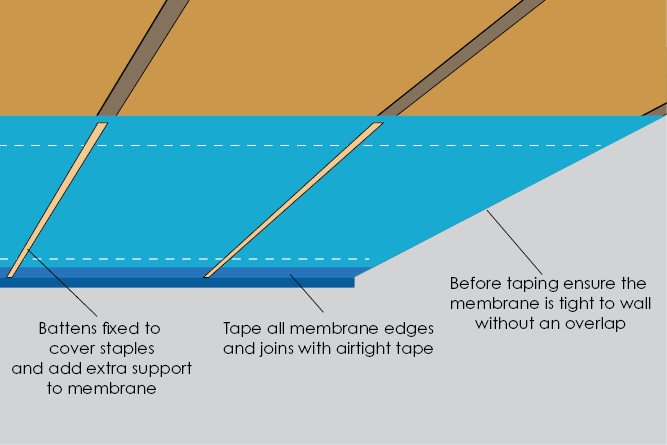
Once the voids have been filled with the insulation, a membrane should be fitted to support the insulation and also provide an airtight seal. Fit the Proclima Solitex Plus with the blue side toward you, running the lengths of membrane perpendicular to the joists. Fix in place by stapling to the bottom of the joists.
Once the area has been covered, seal the membrane overlaps with the Tescon Vana airtight tape. Seal the edges to the walls using the Contega Solido SL tape. Ensure the walls are dry and free of dust, using the Tescon Sprimer to prime the walls where necessary. This will help the tape to adhere properly.
Battens should be fixed along the length of the joists, covering the staples and adding extra support for the weight of the insulation. (see diagram 2.3 below).
Download this guide as a PDF (opens in a new window)