

Mixing Plaster and Coloured Earth Pigments
Posted by Sarah, Celtic Sustainables in Collaboration with Veronica on 19th Jan 2026
Here at Celtic Sustainables, we connect with customers nationwide seeking advice and guidance on how best to use our products. There’s always something new to learn from our customers’ experiences, and we’re always excited to hear their stories. When Veronica contacted Ian for technical support on using lime and pigments, they engaged in several discussions before Veronica felt confident to experiment with Coloured Earth Pigments and Lime Green Lime Plaster. Working with natural pigments and lime involves trial and error, which makes the process both challenging and rewarding. Veronica later reached out with an update on her experiment and the final appearance of the plaster in the annex renovation, and we were thrilled to see the successful result.
Colouring Lime Plaster with Natural Pigments
Below is Veronica’s experience using Coloured Earth Pigments.
I’ve been building an annex in the garden of our Somerset farmhouse in a very hands-on way.
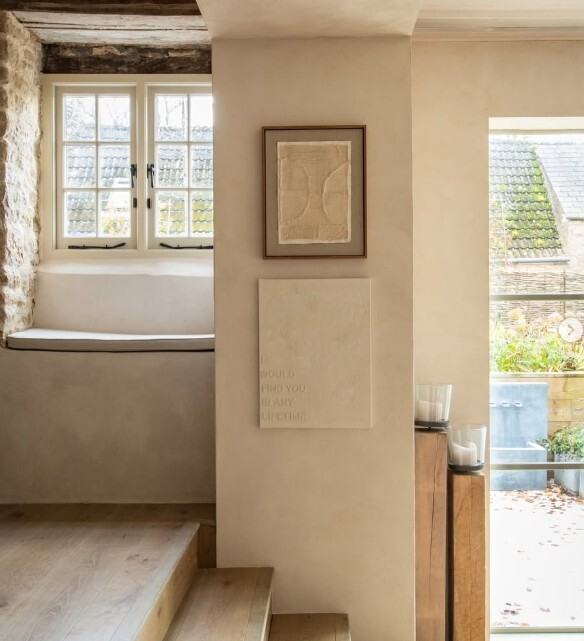
When it came to the walls, I’d decided I wanted a limewash with a textured effect in a warm, peachy tone. With some help from Google, I realised I could achieve this at the plastering stage by adding pigment to the lime plaster, thereby avoiding the need for painting. As I’d planned on plastering much of it myself, I wanted to use a ‘mix with water’ product. Unfortunately, there is very little information on the colours that can be achieved by mixing pigment with a product like Lime Green Solo, so following a conversation with the very helpful tech department at Celtic Sustainables, I decided to undertake a colour mixing experiment.
Pictured (right): Lime Green Inspiration for peachy lime plaster
Lime Green Solo is a one-coat lime plaster designed for interior masonry applications, offering ease of use for both professionals and DIYers to ensure a high-quality finish. Unlike conventional lime plasters, Solo is specially formulated to deliver a smooth finish in just one coat, significantly reducing project duration. It arrives pre-mixed with lime, sand, and chalk; simply add water, stir, and it's ready to apply, eliminating the need for complex on-site mixing ratios.
To echo Ian’s advice regarding testing lime and pigments: it’s always a process of trial and error. Always test on a sample board and let it dry completely. The colour of the wet lime plaster will differ from the finished dry colour, as lime lightens as it carbonates and cures.
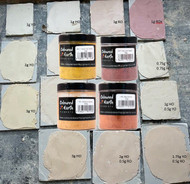
Following their advice on colour ratios (300g:25kg max. or 3g:250g) and process (dry mix the colour with the plaster before adding water), I mixed up a variety of colour tests using 250g of plaster and carefully weighed out grams of colour with a microscale. I ordered 100g pots of yellow ochre (YO), Havana ochre (HO), red ochre (RO), and red iron oxide (ROx).
These are Veronica's results:
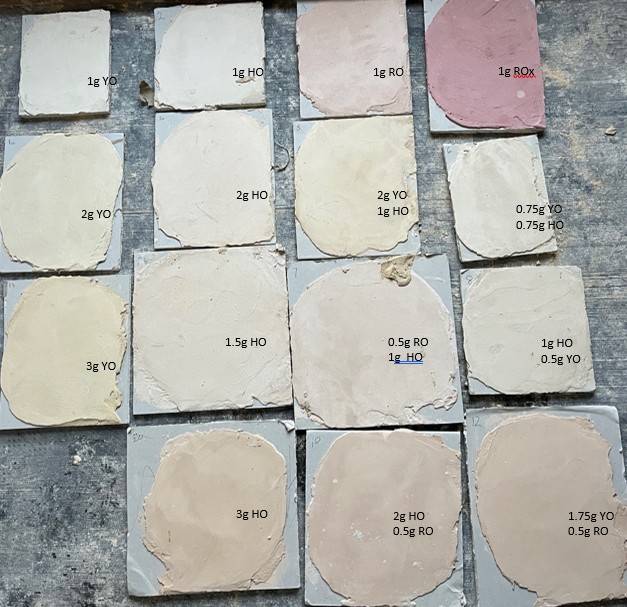
When doing the tests, I discovered they took about 4 days to dry out fully (in an unheated room in November), and I probably smoothed some of them too much based on the fact that I wanted a textured finish; the smoothing made them appear lighter.
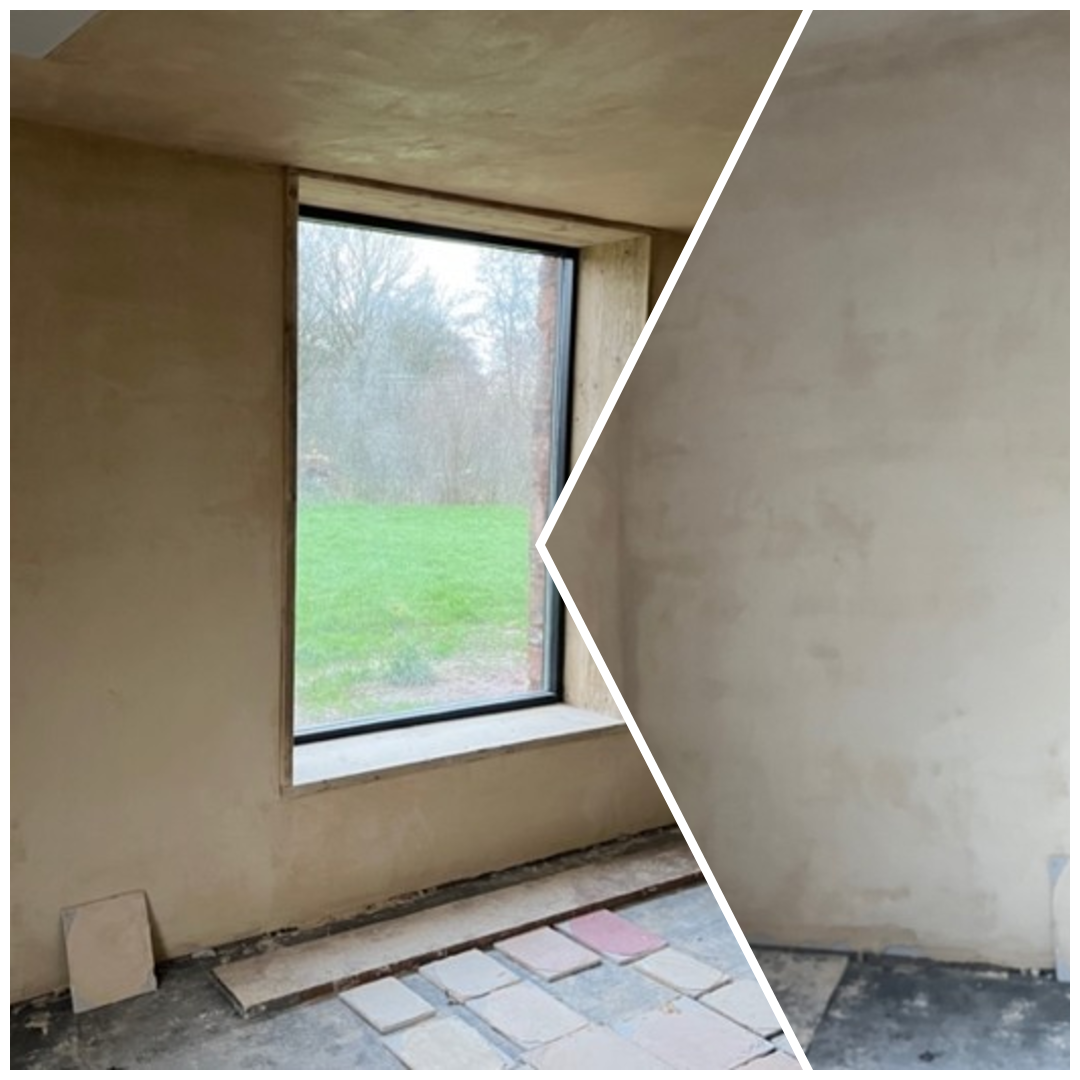
These final photos show a room plastered with our final choice – 2g/200g YO and 1g/100g HO (with the tester propped up against the wall). These were taken in natural light on a dull day in December, around 3 pm. In different lights, from various angles and on different walls, the colour unfolds in a multitude of beautiful tones. Although the textured finish is clearly evident on several walls, the overall effect is darker, which I’m delighted with.
✦ Veronica's advice for anyone using pigments and lime for the first time:
- Thoroughly mix the dry ingredients before adding any other components.
- Limit the pigment to no more than 300g per lime bag to ensure proper consistency.
- Consult a professional lime plasterer for guidance; their expertise is invaluable for correct application techniques.
- Be mindful of lime drying times, which can take several days. Patience is essential to achieve the desired colour and finish.
- Don’t make the same mistake Veronica did: They made a mistake in the quantities they needed to order because they mistakenly assumed that 1 L was equivalent to 1 kg. For reference, 1 L of yellow ochre weighs approximately 600g, although other pigments vary in weight.
A litre of pigment doesn't weigh exactly one kilogram because the density of pigment material usually differs from that of water. Additionally, each pigment colour has a unique density for comparison.
About Natural Pigments for use with Lime
✦ A little more detail on coloured Earth Pigments:
Most coloured earth pigments are suitable for tinting various traditional plasters, such as lime, clay, cement, and gypsum. When choosing pigments, it is crucial to select those labelled as "lime stable" because they are designed to resist fading and discolouration over time, maintaining long-lasting vibrancy and aesthetic appeal. Lime stable pigments are formulated to endure the alkaline environment of lime-based plasters, which can cause standard pigments to degrade or shift in shade. Apply these pigments carefully, mixing thoroughly to ensure even colour distribution, and always follow the manufacturer’s instructions for optimal results.
✦ Example Pigments Suitable for Lime:
Yellow Ochre, Red Ochre, Burnt Sienna, Burnt Umber, Green Earths (Terra Verte). Black, Red, Yellow Iron Oxides, Ultramarine Blue, Ancient Greens
✦ Mixing and applications
The recommended maximum addition of Pigment to a lime plaster / lime mortar is 10% of the lime addition (ignoring the sand and water). So, for a 25kg bag of drymix lime with a mix ratio of 1 part lime to 3 parts sand, the lime addition would be approx 1 quarter of the total weight = 6.25kg. So the maximum recommended addition of pigment would be 625g per 25kg bag of ready mix.
- Pre-mix dry pigment with a small amount of water to create a paste before incorporating it into the plaster mix.
- Use a mixing paddle or whisk to ensure even dispersion of the pigment.
- Gradually add the pigments to the plaster mixture, blending thoroughly after each addition.
For more helpful guides, including our comprehensive lime guides, visit our sister site on coloured earth pigments: https://colouredearthpigments.co.uk/faqs-guides/ and https://www.celticsustainables.co.uk/applying-lime-render-and-lime-plaster/
We hope you find these resources useful for your projects.